All posts by admin

future of iiot

What about the future of the Internet of Things?

Not long ago we used landline and did not even think that once the vacuum cleaner would clean our apartment even in our absence. Modern technologies came to us quickly enough, so fast that the vast majority of people do not understand and do not accept the latest technologies. Well, for what it’s worth, we need to move with the times. Moreover, the latest technologies can simplify life and at the same time increase revenue. One such technology is IoT.

Once upon a time, two people were convinced that everyone needed a personal computer. So they founded Microsoft and made society more advanced. It improved the lives of the people and made the learning process easier. Now in the world, there are very few people who do not use a phone, laptop or tablet. It has become part of our daily lives.

It would seem that everything is ok and nothing else is needed, but the technology industry promised to make improvements in everyday life and promised many advantages. The current goal of the industry is to combine everything with everything and information exchange. Now everything in your environment can be “smart.” Starting from a toothbrush and ending with a motorcycle helmet.

We’ve all dreamed we would drive flying cars a long time ago, but this is no worse than our expectations.

In order to understand what the future of IoT is, we need to divide it into several separate parts. There is a Consumer IoT and Industrial IoT. The first technology relates to household goods and services. Industrial IoT is all about services and complete solutions for large organizations and enterprises to improve productivity and reduce manual work.

Prediction in Industrial IoT

One of the most useful and important advantages of the IoT existence is the maximum improvement of work processes and increase production efficiency in general. The future of the internet of things in the industrial sphere is a lot more important and disruptive than anywhere else.

If a device breakdown occurs in production, the sensors automatically provide information on where the failure occurred and what became the trigger. Moreover, the sensors can also predict when a breakdown will occur and warn the manufacturer about this by exchanging information between the sensors.

The sensors perform work designed to analyze all possible sounds, vibrations, and temperatures. These data make it possible to understand whether the device is working correctly and what condition it is in. State monitoring takes a lot of time if all this is done manually.

Therefore, the introduction of IoT devices is an important step in improving productivity and increasing profits. Based on our experience, simple and quick installation of the device, as well as its ongoing maintenance are key points in the operation of IoT. Popular communication protocols are often used to fully optimize device connectivity. It is important to say that the popularity of protocols does not provide high-quality and efficient connections. This probably will require customer’s intervention and time-consuming solutions to the problem, namely management, configuration, and even maintenance. All this takes time and effort, and, in turn, reduces the efficiency and profit of production.

Ubiquitous connectivity is a new patented method developed by Vixtera. This is a common protocol for connecting, managing devices and collecting the necessary information. This comprehensive solution prevents all time-consuming processes including the creation of specialized software. Ubiquitous connectivity is a solid step into the future of the internet of things.

What’s wrong with IoT?

Privacy

It used to be difficult to live due to the lack of certain devices, sources or labor. Now we have everything we could wish, but life became less freedom. Yes, the phones have improved our lives, now we don’t need to send letters and worry about our loved ones if they left somewhere. But now the Internet knows everything about us. This can be a problem.

Most people do not consider their smart devices as mini-computers, and therefore they do not attach importance to security. Any gadget that is connected to your network may be a subject of attacks by cybercriminals. This may entail a theft of personal information for further sale. Namely, the use of your data for marketing purposes, in creating bots that will subsequently send unwanted malware, spam and possibly organize DDoS attacks.

Reliance

Children who have grown up in the digital world are heavily dependent on gadgets. They solve any problem using these devices without including their brain. This is having a negative impact on academic performance as well as personal development. If the younger generation continues to depend so much on gadgets, then we will get adult individuals who are not able to engage in critical thinking, analytical learning, concentration.

Unemployed people

The future of the internet of things is bright and improved, but there are people who don’t appreciate these technologies. We are talking about workers who can be replaced by robots and devices with mini-computers. These professions include security guards, cleaning staff, and low-skilled people.

What’s great about IoT?

IoT is an incredible opportunity to track any information while being far far away from the needed place. The ability to find out the temperature in the house, the condition of the meters and control the watering of the garden. The future of the internet of things in the industrial sector is equally positive. Production and factories can have all the information about any device that will help to make further moves. The implemented IoT technology will make any industrial enterprise safer. As we said earlier, this technology has a prediction function. If, for example, the oil in the engine is about to reach its boiling point, all employees will be warned and be able to make the appropriate moves.

Future of the Internet of Things. 

Adaptation

Since IoT integration has occurred relatively recently, people are not yet ready for the widespread adoption of IoT devices. Therefore, the IoT market is developing a little slower than anticipated. Nevertheless, this does not interfere with making optimistic forecasts. A common use of IoT is, for the most part, voice control of devices, therefore there are some problems. For example, it will take a long time to connect and configure device data, as well as provide interworking. That’s because there will be a reorganization of networks and a change of technology for the future operation of various devices for the IoT implementation.

Security

Although IoT is a fairly new technology, it also has problem areas. One such issue is security. Therefore, hardware firewalls will become quite common due to the large number of devices that are connected to the Internet. Accordingly, users will be more careful with the choice, and this, in turn, will create a favourable environment for developing better solutions to protect users from attacks, hacks, and viruses.

Stocktaking

The future of the Internet of Things is almost our Present. We encounter internet-connected devices every day. They simplify our everyday life, and also solve more serious problems in Industrial life. In the near future, we will deal with more serious IoT units, as well as with various tasks that, subsequently, will need to be solved. Security in this area is an extremely urgent problem, but it is also a trigger for most companies to start developing solutions that provide complete security for IoT devices and their users.

IIoT

What IIoT and IoT are?

IIoT has been variously called the concept, the set of solutions and just a new technology. But this does not change anything since the Industrial Internet is the interconnection of physical devices that not only collect information but also exchange it. As the Internet was previously created to combine computers around the world, IIoT is now working the same way, connecting devices.

This system (IIoT) is a quick response technology but it is not only the ability to transfer any data at the time of its emergence but also correct the situation. A quick response is especially important if it is some valuable resource, such as energy or water. For example, it can even be a weather or water sensor, or a gauge in agro production, which transmits data on the state of the soil.

Initially, key hardware is equipped with sensors, gauges, controllers, or any other monitoring device. Further, these devices monitor the status and collect information, which will subsequently help the company deal with the provided data and make a decision.

In production, there may also be another situation where Artificial Intelligence will participate. For example, some equipment fitted with a sensor, it collects information and transmits it via the Internet, then a decision is made according to information received. Implementation of AI will make production more successful, cut costs and reduce the presence of the human factor, which often affects the results of an enterprise. If some kind of failure occurs, AI takes this into account, corrects an error, analyzes and remembers the action made. That is, AI is prone to learning and further improving its actions.

AI is a universal assistant in many areas of life. For example, with its help, you can save on energy consumption and any resources. To begin with, you can track the use of certain sources and provide statistics. Later, AI will optimize and save resources in real-time, thereby reducing costs.

IoT and what does it mean?

IoT is not only one device that interacts with each other. It is also a connection method that complete without human intervention, that is, a machine with a machine. They generate big data and, subsequently, exchange it. The collected information is later analyzed and used to improve the equipment status, as well as decision making.

IoT in its actions is not much different from IIoT. The technology also collects and analyzes the received data, which will be further used to improve functioning.

IIoT and IoT. Ways of applying

IoT

It is important to understand one important point and the main difference between these technologies. IoT is about everyday life and improving comfort for people. The scope is only domestic. The most striking example of the application is the technology of “Smart Home”. Any part of your home can be controlled by this new technology:

  • To save lighting, you can use a sensor that will respond to the presence 
  • Heating system. Sensors can control the temperature according to specified parameters, and if necessary, correct it.
  • Door locks. May automatically close the door if you forget.
  • In order not to waste time monitoring the watering of the garden, you can install a sensor that will automatically turn the water on and off when necessary.
  • Power optimization etc

To use all these amenities, you need to introduce automation into the work of meters. To introduce You need to combine all existing meters into one network, where cost accounting is kept, Thus, the owner will always be aware of how much resources are consumed and will be able to save a lot of money.

IIoT

Most industry challenges are resolved through the implementation of IIoT. This technology is not suitable for everyday use, as it works exclusively with the industrial world. The basis for the functioning of IIoT is the interaction of sensors. There is the monitoring of all mechanisms and devices. All this plays a major role in various fields, ranging from municipal lighting systems to oil production. In the first case, it is traffic control – turning on the light when the sensors see movement and turning off in the absence, respectively.

Major Differences

The purpose of appearing?

Improving and simplifying life is the main goal of IoT technology emergence. This one only applies to the domestic sphere. The goal is to increase economy and safety, but also to reduce costs.

The purpose of IIoT, in turn, is to increase the profitability and various benefits for the production, which are somewhat related to the objectives of IoT.

The cost of breakdown

IoT technology will cost much less and will not cause much trouble under repair. For example, if the floor has not warmed up to your arrival or the vacuum cleaner has not cleaned the room, you can do it manually upon arrival. The same applies to the coffee maker, for example, if your coffee is not ready in the morning, then you can make it yourself. If your house is fully equipped with IIoT technology, then important systems such as fire alarms, door locks, and others will be kept under control all the time because of low-tech duplication tools.

The price for a failure in the IIoT system will be much higher because any violation of a network fragment or incorrect data output can cause a pause in production or its shutdown. If you use the same low-tech tools at a time of a failure, then productivity will significantly decrease.

Is it fast to deploy?

IoT technology is being implemented relatively quickly unlike its neighbor. No large-scale actions are required, and all the necessary components can be bought when replacing household appliances.

The low rate of implementation of IIoT is associated with its scale. To implement this technology is required a complete and fairly large conversion. Unlike IoT technology, implementation is phased. All decisions on the implementation of the update should be made taking into account the possible incomplete reconstruction.

Data processing speed

For any IoT device, the speed of information processing is quite high, almost in real-time. That is, the response time can be up to a dozen seconds.

IIoT as a more complex technology should have more time for processing information, but in reality that’s not exactly true. The data processing speed takes place in hard real-time mode, that is, it takes no more than a dozen milliseconds or even faster. Delays and pauses in this technology are simply unacceptable.

Data Volume

The amount of data in IoT is the same as most of its devices. Devices generate only a few megabytes per day.

Big technologies need big storage for data because IIoT has hundreds of times more amount of data than IoT per day.

What about the Workplace?

There is no threat that the introduction of IoT may lead to the dismissal of at least one employee. It will not cause any problems to either the housekeeper, the gardener or anyone else.

That’s quite another matter with IIoT, because in implementing this technology will occur a huge reduction of all manual steps. It will also begin the search for highly qualified personnel for more serious work, such as design, equipment installation, analysis, and so on.

Information Security Risk

Even though the technology is new, it has flaws, like any other system. More precisely, these are new challenges to society. There is a threat of unauthorized interference with housing or data theft, for example. All of this because of weak built-in protection. One company conducted an experiment where one could log into the cloud storage, get an account, and then gain control of the “smart home” without any problems.

As for IIoT, it’s a lot more serious. Information security risks are quite high because unauthorized interventions can provoke an industrial catastrophe.

Pros and cons

Advantages of IoT technology:

  • labor productivity increase
  • cost reduction
  • improved capital allocation
  • comfort
  • assistance in making economic, domestic and social decisions
  • cost reduction
  • low-cost repair

Disadvantages

  • physical and passive attacks
  • extracting personal information from things controlled by IoT
  • data compatibility problem

Advantages of IIoT technology:

  • timely response to equipment breakdown
  • elimination of theft and downtime
  • increased security
  • material saving
  • reject defect rate reduction
  • identification of factors that affect product quality
  • process efficiency improvement
  • the possibility of better monitoring
  • production line optimization

Disadvantages

  • expensive installation
  • the high cost of repair
  • suspension of processes during the breakdown
  • a large percentage of the probability of an industrial accident (information security)

How can mid enterprises ease their deployment

Both in the large and small markets, enterprises and institutions are faced with a financial problem. No wonder this is a problem because in the world of innovation and modernization it is very important to be in trend. Increasing labor productivity, reducing costs and overall productivity directly depend on modern high-quality equipment.

While large enterprises have already implemented IIoT technology, medium-sized companies cannot afford it, but they no less need it.

Vixtera has a complex way out for such enterprises. The “in-a-box” solution simplifies the implementation of IIoT and helps the company to roll out everything it needs, namely services and ecosystems.

This solution is a lifesaver because #ViEdge Software is easy to configure and contains all the important elements necessary for the operation of the enterprise.

#ViEdge contains automated installations, as well as necessary updates; single panel; a tool that instantly identifies failures both in system and installation as well as their cause.

Vixtera connectivity

Progressive Implementation IIoT in Industrial Life

We are used to the fact that in our life the Internet is present on an ongoing basis. It is the link between a huge amount of information and our brain (people). There is also another parallel branch – the industrial Internet. If in the first case the connection occurs between a person and a machine, then in the case of IIoT this is only a machinery link. Thanks to the new technology, it is not only about time savings but also resources costs.

IIoT vs Cloud

Various enterprises, factories, stations – all of them use gauges and sensors to transmit and exchange a large amount of information. An ideal repository for this voluminous data is the Industrial Cloud. The existence of such a repository provides companies with more accessible and strategic management of data and common processes.

The cloud architecture is an invariable component of the computing cloud and consists of 4 layers:

  • Hardware or physical layer: servers, storage, and other physical parts
  • Platform: middleware, OS, apps
  • Application: accessible software
  • Infrastructure: networking, virtualized servers, storage facilities

Actually, it is inappropriate to compare IIoT with Cloud Computing because in the first case it is just a conception of building infrastructures that connects all non-domestic devices to the Internet: equipment in factories, different sensors, gauges. Cloud is just a repository for various types of data ranging from photos to application data.

These two elements cannot replace each other, but they both perfectly interact.

IIoT and how it works?

IIoT is a concept or integrated system that provides automated management of enterprises and non-domestic devices and simplifies industrial life. With the introduction of IIoT occurs almost complete exclusion of the human factor. Alternatively, all production processes become robotic and automated.

To ensure control of the plants, there must be a connection between both the control and the controlled element. It is important to say that these elements do not have to be in close proximity to interact. But for some industrial applications, it is important to perform the analysis locally in order to track statistics on the spot.

Thanks to the interaction of physical processes and control programs, it became possible to collect information and data from all systems. This, in turn, helps to find out the state of an element, to check, make the necessary forecast, adjust, adapt and repair.

The collection and transmission of data between devices are carried out using various sensors, recorders, and controllers. As mentioned earlier, this system does not require human intervention. The remote server collects all the information from various places into one. Furthermore, Artificial Intelligence comes into operation, which analyzes, processes data and makes the necessary decisions to improve or to correct errors.

Artificial Intelligence

Artificial Intelligence is set to replace humans, but this only can be good. In manufacturing plants, AI can come in handy at absolutely all levels. Starting with design and ending with promotion. This system will be an excellent replacement for manual labor, which is not only expensive but also time-consuming and error prone. People can make mistakes, but if it is possible to introduce AI into production, then the risk of failure will be extremely small.

Since the AI ​​system is a smart one, it is interpreted data from the outside, draws lessons as a real human, and only then analyzes the data and being guided by it applies in practice to achieve goals.

Although the implementation of AI and IIoT will require some costs,  it will greatly improve and facilitate the industrial life of enterprises in the future.

The interaction of IIoT and AI is the perfect symbiosis to increase the speed, productivity and accuracy of production and business decisions.

IIoT provides the collection, movement and storage of information, and AI technology processes this data.

What’s the value of IIoT? IIoT Benefits

IIoT is not only our future but also a confident present. With the introduction of IIoT in production, the goal is to create a digital copy of the proposed products. That is, all this information with a description of products, statistics, and other data is always available. This greatly simplifies the life of industrial enterprises.

It is a well-known fact that the implementation of IIoT in real life takes a long time. It doesn’t happen due to the reluctance to increase production efficiency, but due to some other parameters. Since IIoT is a large-scale implementation, the reconstruction of the infrastructure will be the same. Most often, renovation of production is also required for implementation. In order for everything to be installed correctly, use a phased approach. All solutions should consider scalability as well as compatibility with older sites.

Vixtera RCA 

The root cause detection algorithm, patented and developed by Vixtera, is designed to analyze the root causes of a breakdown. In order for the neural networks to self-learn, and later find and fix errors, it was taken a system failure as the basis.

Mostly this developed method was created to search for failures in real-time. This algorithm will eliminate all errors that the human factor can make when modeling AI, and will also be an ideal source of failure forecasts.


iiot chicken and egg

Solving the IIoT chicken and egg strategy problem

So, what comes first: a chicken or an egg? To obtain the full IIoT capabilities, do you deploy applications and services in the Cloud or at the Edge? 

In the funny “proto-chicken” experience, two birds that weren’t really chickens have ultimately created a chicken egg. A recent Gartner report says that “Neither cloud nor edge capabilities can provide a complete IIoT solution on its own… and require working together”. We agree! BUT, what asset-intensive industries like manufacturing, transportation and utilities are saying?

Why we are for the Edge technology

In our practical experience, IIoTEdge is one that makes it whole while providing vital operational capabilities to a professed IIoT nirvana. To complement, VixteraIIoTEdge: 

  • comprises a distributed software stack of microservices and applications; 
  • connects seamlessly to any device type; 
  • offers advanced asset management, planning and decision making with up-to-the-minute asset viewing, multi-faceted analytics and “Digital Twin” capabilities; 
  • provides with real-time and potential problems findings using provisional, real-time and predictive analyses;
  • is cloud-agnostic. 

One of the main IIoT objectives is to make sure your devices are well entrenched with customers’ value chain. It involves every responsible actor and includes every part of your infrastructure requiring agile networks of smart devices manifesting ever-continuing service evolution and delivery of commercially viable IIoT solutions.

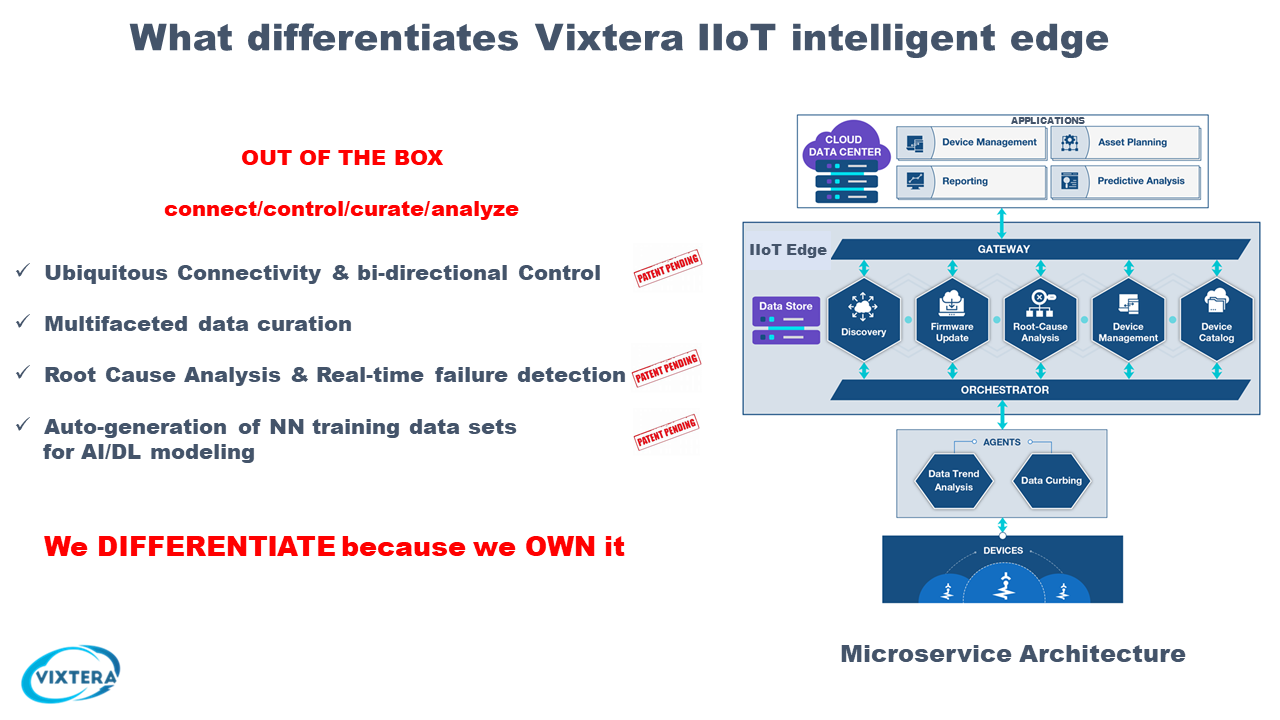
VixteraIIoTEdge appliance employs patented technologies, distributed computing architecture and micro-service framework offering ubiquitous connectivity of intelligent devices augmented by complete visibility and control across the entire IIoT ecosystem. 

From smart data trending to context-based analysis; from connectivity wizard to algorithm-driven rules, protocols and topologies; from real-time failure detection to predictive maintenance, asset planning and digital modeling – the Edge quickly guides you around, transforming data into timely, relevant insights and actions, uncovering and configuring any change and nuance while instantly tying devices to your applications and services. The appliance easily connects to legacy signals and queues enabling rapid integration with OTs while enhancing it with new capabilities.

Microservice architecture

The homecoming of microservice architecture fulfills the IoT industry longing for device connectivity and data sharing. It helps to elevate the efficiency of operation by refining interdependencies between networks and systems elements; enables each microservice to run as a full-featured process, a function; and allows self-contained operation anywhere across the network. 

Its ability to scale yet staying connected becomes the driving force for proliferation of IoT applications. VixteraIIoTEdge software framework is architected as a collection of connected microservices unified by purposely-built processes, functions and applications.

For example, one set of functions runs auto-discovery and configuration of devices while the other two balance collected data and run the root cause analysis. Yet another set of functions, applications, works on reporting, predictive analysis and asset planning – all are in the plurality of connected devices.

The Edge architecture scales horizontally and vertically and deploys in any cloud, premises or anywhere within the IoT ecosystem providing quantifiable ROI and sustainable benefits for IoT deployment and operation. 

vixtera IIoT intelligent edge

Gateways

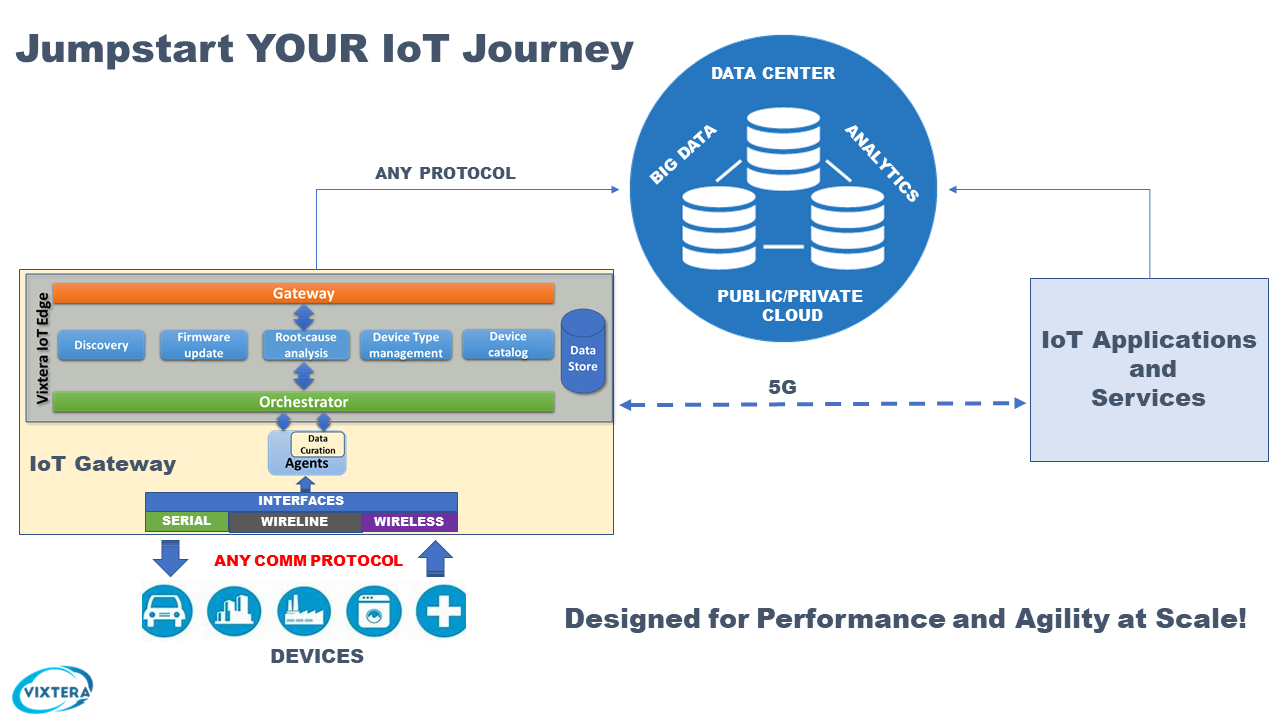
Gateways are essential elements of the IoT ecosystem performing vital tasks of tying THINGS together. They aggregate and secure communications from/to devices via an array of interfaces and send data downstream for further processing and actions. However, despite its great virtues, IoT gateways are missing critical mass of intelligence at the edge delivering quick-n-easy device onboarding, data curation and instant analysis, especially in the data-intensive industrial environment.  

VixteraIIoTEdge patented software radically improves IoT gateways capabilities at the edge equipping users with operationally sound features, solutions and actions. It allows ubiquitous connectivity and complete control of devices whereas helping to derive relevant data, close to action, granularly, in a pre-defined way, providing the ability to supply structured data for the variety of analysis.

The Edge accurately pinpoints a problem in real time and uses it to deliver a reliable source for NN training and AI/ML modeling, thus, driving consistently-good quality data for predictive applications and services.

iot journet

Identification of problems

Running IIoT mission-critical applications and working within an asset-intensive industrial environment requires a solution that’s capable of identifying and resolving failures in real time yet providing a robust mechanism for prediction and prevention of potential problems.

Vixtera developed an algorithm that helps to detect systems anomalies and instantly identify the source of failures. The patented methodology makes certain assumptions about input and outputs of malfunctioning devices, its internal and external environment – all in the plurality of connected ecosystem. It promptly determines a root cause and a chain of events that are leading to a problem significantly reducing the downtime and emergency maintenance while improving device serviceability and use of resources. 

The failure event can be used as an “etalon”, a reliable label, for automatic NN training and AI/DL modeling, eliminating costly, error-prone human involvement. It fundamentally refines AI processes fitting highly dependable data for predictive analysis whereas generating trustworthy outcomes for the variety of predictive and prescriptive services.

iiot anomalies and failure detection

This is why we believe the Edge technology is the best IIoT solution. It connects all devices into one system that is easily managed and controlled. This way data processing becomes faster and the results are more relevant. Another benefit is failure detection and predictive analysis. Learn more about all the opportunities visiting this page.

More about IIoT software appliance: https://vixtera.com/software-appliance/

iiot stages

Three tiers of an efficient IIoT solution

The deployment of IIoT means the cooperation of software and equipment. These parts of a solution work in different ways, that’s why the flow of data should be well-thought-out and structured. Vixtera offers its own technology that allows collecting, filtering, processing, analyzing and displaying information for the whole system. In this article, we will describe the three tiers where the mentioned operations are performed and how they are related.

OT/IT convergence and data governance

At the core of these new offerings is a massive amount of data generated by devices and transmitted over the IIoT infrastructure. Collecting, processing and managing data, from devices to high-level enterprise applications, requires new tools and capabilities.

Architecting a successful IIoT deployment involves new ways of thinking about machine-generated data, and requires new levels of collaboration across the organization. As data is collected from the field, there are overlaps and synergies between traditionally separate domains of Information Technology (IT) and Operations Technology (OT).

For example, IT personnel typically focus on networking and productivity technologies and may not have direct experience working with industrial equipment deployed in the field. By the same token, OT personnel typically focus on the very specific processes required for industrial control and may be new to the nuances of gathering, transmitting, and protecting data in the IIoT environment.

Creating an effective IIoT deployment requires combining expertise from IT and OT and, so, when it’s done well, it breaks the barriers between two groups. The resulting convergence creates a new operational blueprint and prepares organizations for scalable and sustainable growth. Below are three stages that enable this process.

1. Application tier 

This tier comprises reporting, remote monitoring, and predictive modeling. The Application Tier interfaces with the enterprise, using a service network to communicate with mission-critical applications like ERP, CRM, modeling and maintenance. The Applications Tier uses data from the field to build company-specific functionalities and fulfill business requirements. Many enterprise applications are supplied by the third-party partners who have already designed the solutions and/or frameworks to accept the IIoT data. 

2. Data & analytics tier 

In this tier, the data from devices gets assembled, processed and analyzed. The task of preparing data for use by other applications requires substantial computing resources and can take place in the public cloud or within the enterprise’s data center or private cloud. In many instances, especially related to industrial use cases, the data analytics must be performed on the premises, closer to data collected devices. The Data & Analytics Tier serves the Application Tier by creating and streaming operational data. Data in this tier can be used for real-time analytics or placed in the long-term storage for historical reporting.

The functions performed by the Data & Analytics Tier are often supplied by the same third-party partners who’re furnishing enterprise applications. Many of these applications provide a set of open protocols for connecting the data integration layer of the Data & Analytics Tier to the network-access functions of the Edge & Connectivity Tier. The open nature of these interfaces simplifies the work of accepting data from devices and prepares it for use by enterprises.

3. Edge & connectivity tier

This is where data is collected from devices and sensors, analyzed and filtered to cut out noise, errors and repetitions, and is delivered to Analytics and Application tiers. It’s critical, at this tier, to optimize data governance identifying the shortest path to analytics engine and the least amount of data that may impact your most critical business outcomes. Providing data consumers with a single view of the metadata and giving them the opportunity to provision a curated inventory of metadata is a necessary step toward the practical implementation of all analytics and AI/ML processes.

The edge takes care of IIoT “essentials”, connecting to and managing devices, events and data. On one side of the edge is a local network that communicates with devices via various hardware interfaces and an alphabet of communication protocols. And on the other side is an access network that communicates with Data & Analytics Tier via a collection of open and semi-proprietary protocols. This is a tier with a ton of not well-publicized and “hidden minefields”. And, so most of the existing IIoT platforms may require significant DIY development (drivers, software) to stick it all together – connecting devices and adapting them to applications. So, watch out for solutions that help you simplify these lengthy and laborious processes. 

Figure 1. ViEdge Data Management

At every step in the way, Vixtera makes it simple to facilitate your IIoT journey. To get you started, we offer an extensible pre-built software framework with run-time core components and empower you with a variety of services to assist with the rapid productization of your solution and integration with platforms and clouds. To get inspired and to learn about Vixtera innovations and solutions, please visit us at www.linkedin.com/company/vixtera-inc